SPP’s Large Load Integration path looks good now!
Why I'm No Longer Skeptical About SPP's Large Load Integration Plan.

I had previously expressed concerns with SPP’s Large Load Integration effort. In this post, I aim to explain how these concerns have been addressed.
1. 90-day study timeline concern – The concern was whether SPP can realistically turn around and provide study results to large load developers within 90 days. After speaking with SPP, I am convinced that SPP is serious about achieving a 90-day turnaround time. Suppose all the data is provided to SPP staff in advance by the load customer via the serving entity. Yes, there will be instances where a short circuit would have to be done, but SPP believes those instances will be fewer.
There is also another nuance here. If load customers are bringing generation along to study (they are not required to do so, but if they do), it is the same 90-day study window, not an extra 90 days. That’s a good thing for the load customer if they plan to have on-site batteries or diesel generator sets for backup power, for example.
For more information, please refer to the three options SPP outlines – the Common Bus, the Local Area and the Deliverability Area. The last option is akin to generators seeking interconnection service and receiving Network Resource Interconnection Service (NRIS).
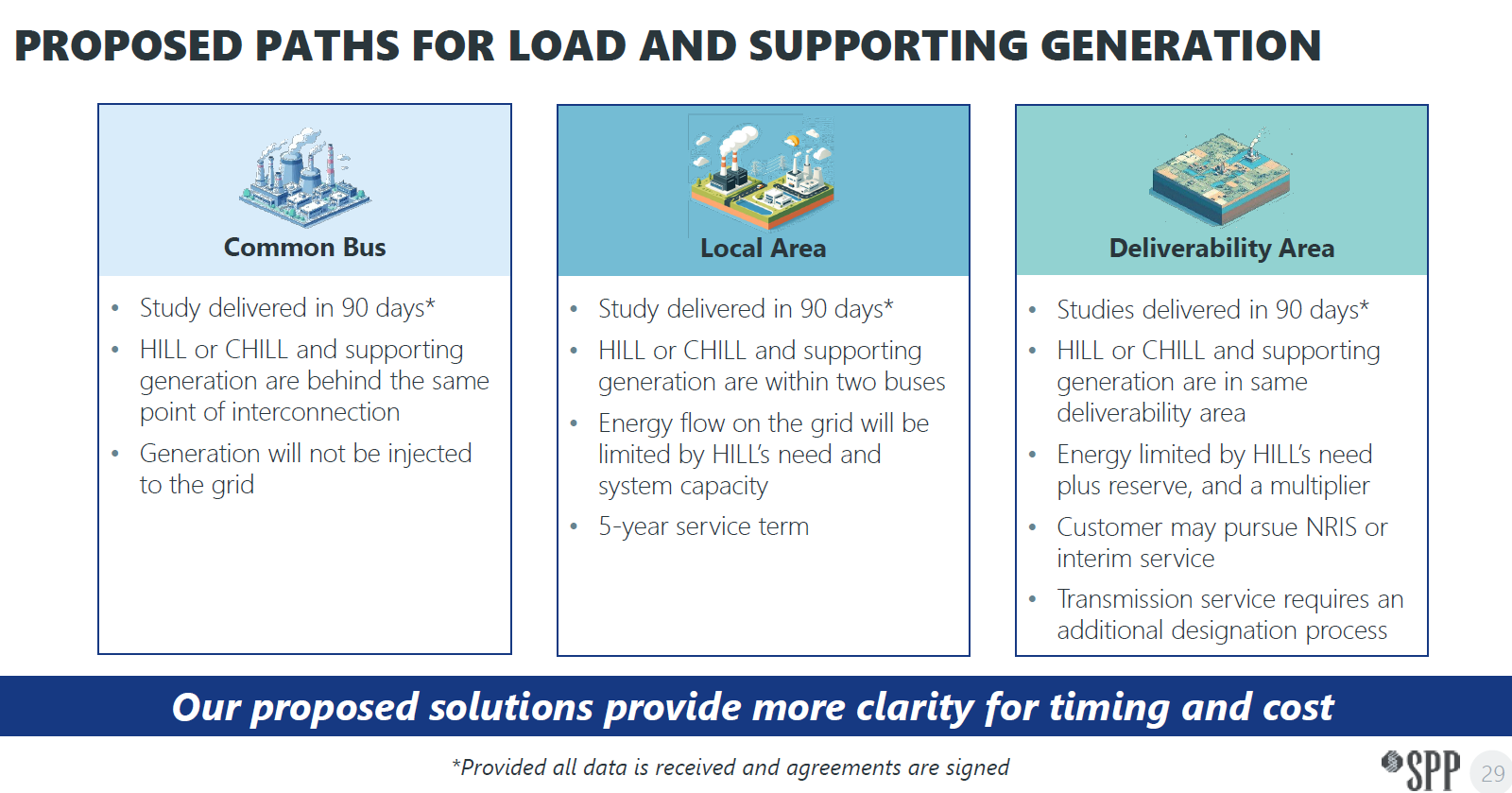
Source: SPP
Hence, this concern regarding the 90-day study timeline is addressed.
2. Concern around what exactly the large load is paying for when requesting the “conditional” service - Recall, SPP is pursuing this effort to provide large load customers with a service towards full transmission service. The end goal is, after the end of this “conditional” service (aka CHILL), the load will pay for transmission upgrades and become a “firm” load customer of the load serving entity.
Until the 5-year term expires, the load customer, if choosing the CHILL path, is granted conditional transmission service, provided they register with SPP (see Q3.6 in SPP’s FAQs updated recently). SPP can curtail large loads when required for balancing purposes. If SPP is serious about adhering to the 90-day study timeline, it is also serious about the 5-year term for this CHILL service. SPP does not want large loads to remain “conditional” without paying for “firm” transmission. Hence the 5-year term.
3. Concern about who curtails the large load – I had expressed concern about who is exactly sending the signal to curtail the large load customer’s output. The answer is SPP via its “Conditional Load Advisory”. SPP will have visibility into the large load via XML protocols. SPP plans to issue this Advisory for large loads to curtail when needed under this CHILL service. (see new questions added to SPP’s FAQs – 3.7-3.9) Large loads always have the option to pay for transmission upgrades and become HILLS.
4. The role of LSE – Yes, the role of the LSE is the gatekeeper in this new process. Large load customers are directly going to the LSE, not the SPP, due to jurisdictional issues. Ultimately, the load customer seeks interconnection with its utility – the LSE - and the LSE involves SPP in running this 90-day study to provide this conditional service. (See “Only load-serving entities authorized by their state regulatory authority can request large load interconnection service through SPP” Q8.4 in SPP’s FAQs)
5. Stakeholder Process – As some of you already know, SPP’s MOPC rejected the proposal in a vote recently. There is a special MOPC on SPP’s calendar on August 21. Now, SPP plans to present this proposal at multiple stakeholder committees and seek Board approval next month. (See “Subject to board approval, SPP will submit tariff changes to FERC in August 2025, with a request for approval within 60 days.” Q8.2 in SPP’s FAQs)